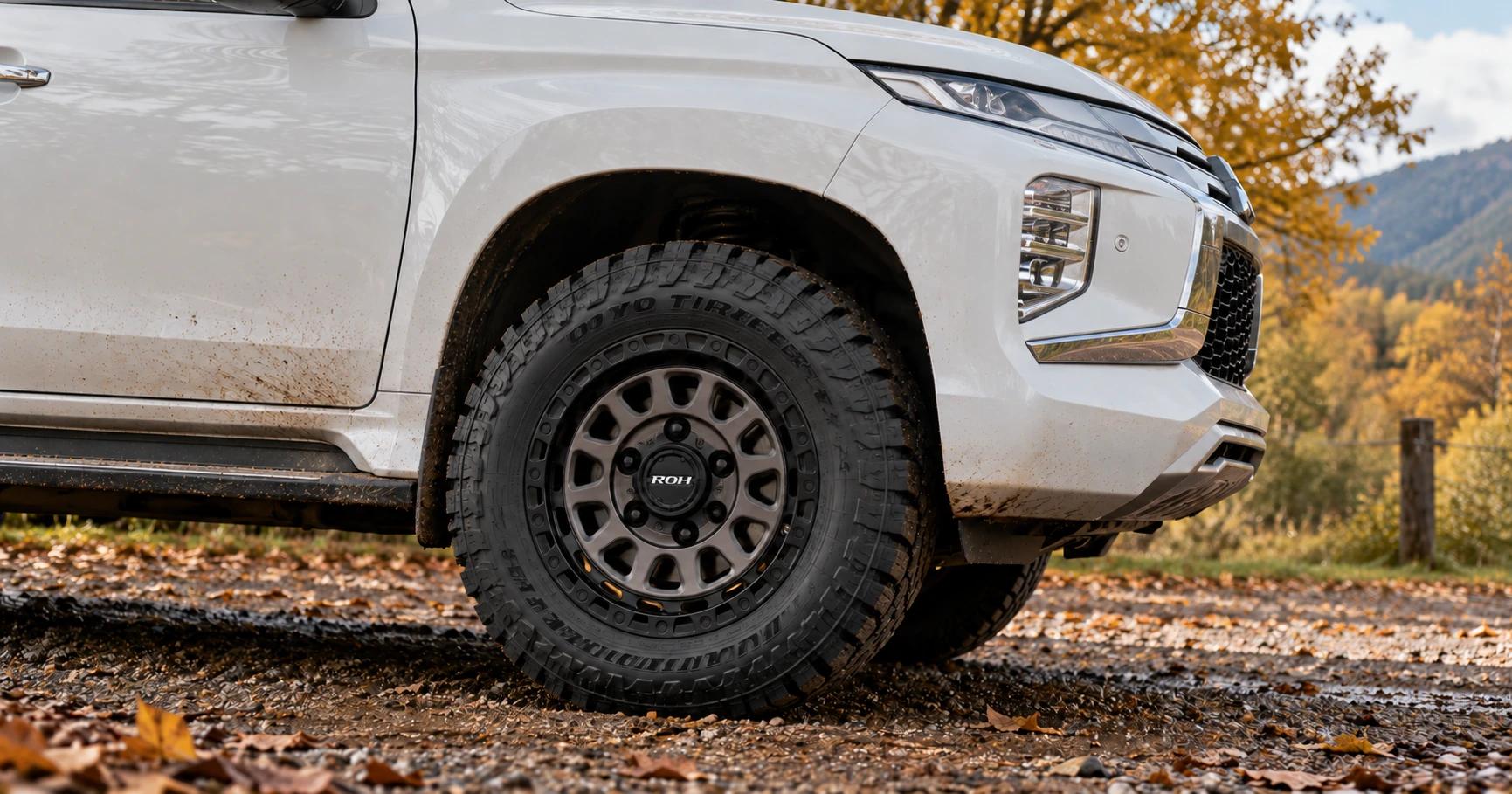
Wheels
Pajero Sport wheels: what sizes and offsets fit?
Find documented Pajero Sport wheel sizes, stud patterns and offsets, then check tyre clearance, load and the Queensland and Victorian track rules.
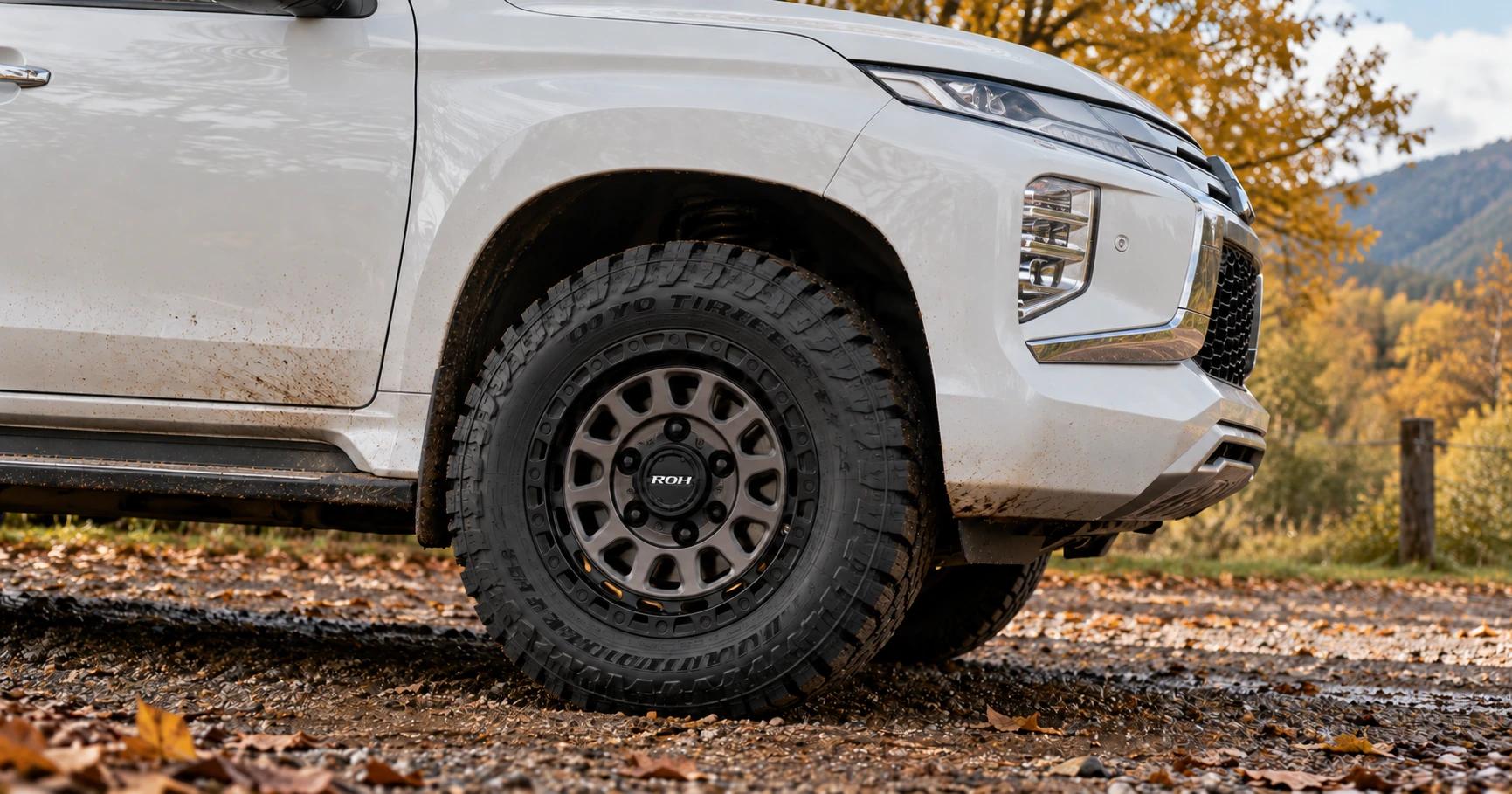
The documented Pajero Sport wheel examples below use 6x139.7, with 17x9, 18x9 sizes and +25 mm offsets in the stated applications. These are wheel-maker examples, not a claim that the largest listed rim is the physical or legal maximum.
Australian 2015 to 2025 Pajero Sport application, including QE/QF-era vehicles. The factory example is the cited 25MY brochure. Full-size Pajero, Challenger and successor models are excluded.
What is the largest wheel size worth fitting?
Keep Pajero Sport separate from the full-size Pajero. The checked 17x9 +25 Crawler is explicitly for ROH's 2015 to 2025 Pajero Sport application, rather than a general Mitsubishi fitment.
A larger metal wheel does not necessarily mean a taller tyre. For touring, our preference is the smallest wheel with a confirmed brake application that supports the chosen tyre and load. For a road-focused look, a larger wheel can be considered while keeping a suitable outside tyre diameter. That is a style and use-case choice, not proof that an unlisted rim fits.
What factory wheel and tyre sizes are documented?
These are scoped examples, not a size chart for every year or variant. Match the tyre placard and wheel markings on your own vehicle. Read the original reference.
| Tyre size | Documented scope |
|---|---|
| 265/60R18 | Cited 25MY Pajero Sport brochure package |
Choose tyre diameter and wheel diameter separately
The wheel is the metal rim inside the tyre. A larger wheel does not necessarily make the complete assembly taller: tyre sidewall can decrease to keep a similar outside diameter.
For the 265/60R18 reference, nominal outside diameter is 775.2 mm and sidewall height is 159.0 mm on each side. If the same outside diameter were maintained on a 17-inch wheel, each sidewall would be 12.7 mm taller. This is geometry, not proof that a matching tyre product or brake-clearing wheel exists.
For touring we would compare sufficient sidewall with the look you prefer, rather than choosing the largest visible wheel. Keep the wheel barrel, caliper clearance and the tyre's approved rim width in that comparison.
What stud pattern, wheel width and offset fit?
Selected vehicle application
ROH's current table lists the following examples as recommended for that selector.
Mitsubishi Pajero Sport: manufacturer wheel examples
17x9
- Stud pattern
- 6x139.7
- Offset
- +25 mm
- Published wheel load
- 1500kg
- ROH label
- Recommended
18x9
- Stud pattern
- 6x139.7
- Offset
- +25 mm
- Published wheel load
- 1500kg
- ROH label
- Recommended
A wheel manufacturer's application and load rating do not approve every tyre fitted to that wheel. The exact part number, attachment hardware, brakes, tyre, vehicle load and modifications still need to agree. These examples explain specification choices; they are not a ranking of wheel brands.
Read the wheel marking

How far will a different offset move the wheels?
Offset is the distance between the wheel centreline and its mounting face. With width unchanged, reducing a positive offset, or making a negative offset more negative, moves the wheel outwards.
The offset values below illustrate the change between two same-width wheels. They correspond to the selected ROH example and a lower-offset option where documented; the diagram itself is not a fitment approval.

Moving from ET +25 to ET +12 at the same nine-inch width moves each wheel 13 mm outwards. A matching pair increases track by 26 mm, assuming the original hubs and axle geometry stay the same. This says where the wheel moves, not whether the tyre stays covered or clears the vehicle.
Why wheel width matters too
A change from an eight-inch rim to a nine-inch rim adds 25.4 mm of nominal width. At the same offset, that places each nominal rim edge 12.7 mm further from the centreline: one edge moves out and the other moves in. The tyre section itself is not the rim width.
If width and offset both change, compare both dimensions. The outward rim-edge change is half the width change in millimetres, plus the old offset minus the new offset. Actual tyre bulge and rim-lip shape require the product data and a physical check.
Should you choose the biggest rim or more sidewall?
Consider the wagon as a loaded touring vehicle, including its underslung spare and passengers. A change from the factory 18s should solve a real tyre or appearance preference rather than simply copying a Triton wheel photograph.
For a daily or restrained tourer, our first visual comparison would use a wheel that keeps the tyre within a technically suitable package. Then compare dark, bronze and machined finishes against the actual vehicle colour. The best-looking choice is personal; a negative number is not automatically a better stance.
What wheel offset is legal in Queensland or Victoria?
There is no single legal offset number for every Pajero Sport. Work from the manufacturer's maximum wheel track for the particular model and assess the front and rear axles separately. A wheel manufacturer's ‘recommended’ label does not replace that calculation.
For eligible off-road and goods vehicles, Queensland's current minor-modification guidance and VSB 14 Section LS clause 4.2.11 used in Victoria set a 50 mm maximum track increase over the manufacturer's maximum. Passenger-car rules differ. With unchanged hubs, moving each same-width wheel 25 mm out increases track by 50 mm. That is an illustration, not permission to subtract 25 from any wheel already fitted.
Tyres must remain covered and clear the vehicle through steering and suspension movement. Wheel load, tyre-to-rim approval, brake clearance, speedometer accuracy and any existing approval conditions still apply. Flares address coverage; they do not increase the permitted track or tyre-diameter allowance.
Read the Queensland tyre, lift and wheel rules or Victoria's tyre, lift and wheel rules for the conditions and approval routes. Melbourne follows the Victorian rules. These are not a national legal offset chart.
Before placing the order
- Confirm generation, grade, build date and any existing brake, axle or suspension changes.
- Obtain the exact wheel part number, stud pattern, attachment hardware and brake-clearance application.
- Match tyre model and size to the wheel's approved width and the vehicle's required load and speed specifications.
- Check tyre coverage, full-travel clearance, spare-wheel compatibility and the state requirements for your complete wheel, tyre and lift package.
Questions about Pajero Sport wheels
Does a Triton wheel automatically fit a Pajero Sport?
No. Confirm the Pajero Sport application, exact wheel part number, caliper clearance and load. Matching bolt holes do not establish those other requirements.
Does the stud pattern alone prove a wheel fits?
No. Confirm centre bore, wheel-nut seat and thread, brake clearance, load rating, width and offset for the exact part number. The matching spare also needs a practical mounting and clearance check.
Can I use a wider wheel with my existing tyre?
Only within that exact tyre version's approved rim range. A nine-inch wheel appearing in a vehicle application does not make every factory tyre suitable for it. Read the manufacturer row, including LT, passenger or XL construction, before combining the parts.
Compare wheels on your own Mitsubishi Pajero Sport
Use your own photo to compare the designs and finishes available in Nordak. Keep the whole build in view, including the bar, tray, canopy and paint. See wheels on your vehicle, then take the preferred look and exact specification to your supplier.
Nordak shows appearance, not verified fitment. The companion tyre size guide explains the diameter changes before you settle on a package.