
Canopies
MITS Alloy canopy sizes explained: 1000 vs 1320 vs 1500 vs 1700
How the MITS Alloy canopy lengths compare, how much open tray each one leaves and which size suits a touring or work ute build.
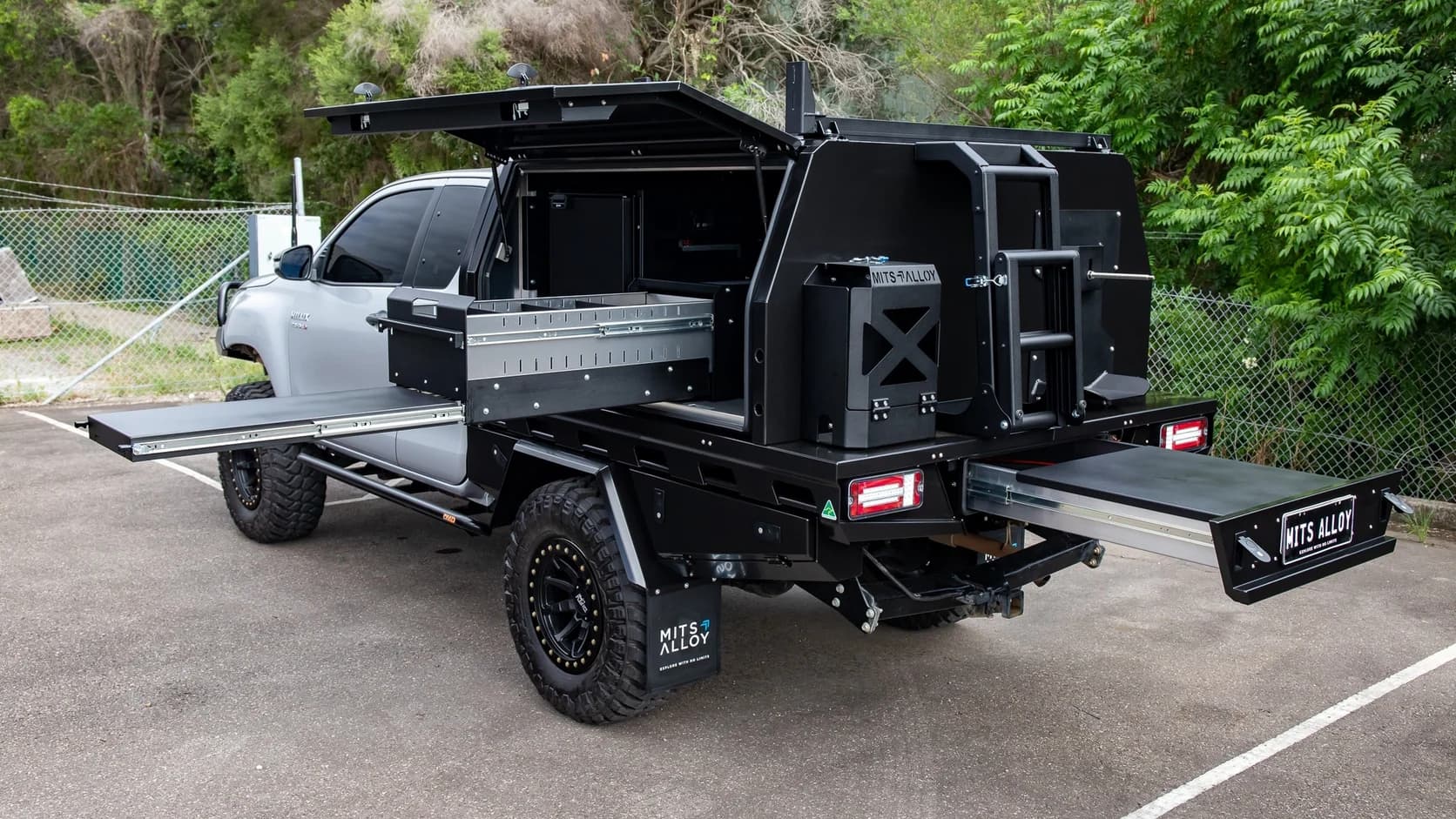
Choosing a MITS Alloy canopy is not about finding the biggest one that fits. It is about deciding how much enclosed storage you need against how much open tray you want to keep. On a dual cab that decision comes down to four published lengths: 1000 mm, 1320 mm, 1500 mm and 1700 mm.
The dual cab tray deck is 1765 mm long, so the choice is close to zero-sum. Every millimetre of canopy is a millimetre of open deck you no longer have.
What this guide covers
The current Australian MITS Alloy canopy range, focused on the dual cab sizes because that is what most touring buyers are choosing between. It also covers the extra cab and single cab ranges, what the modular interior can hold and the weight conversation that a longer canopy makes unavoidable.
It is not a fitment guide. MITS publishes one vehicle list per cab type, covering HiLux, Ranger, D-Max, BT-50, Triton, Navara, Gladiator, Amarok from 2023 and the 79 Series. That is manufacturer-level family coverage, not confirmation for your exact year, grade, body and drivetrain. American-market canopies for RAM, F-Series and Silverado trays are out of scope here.
We have also not tested these canopies against rival brands, so nothing below says MITS is the best canopy you can buy. It says what the range is and how to choose within it.
The short answer
- 1000 mm: the lightest option and the most open deck, around 765 mm behind the canopy on a dual cab. Best when the tray is the point and the canopy is secure storage on the end of it.
- 1320 mm: a genuinely compact touring canopy that still leaves roughly 445 mm of deck. The best compromise if you regularly carry something dirty, long or awkward.
- 1500 mm: the sweet spot for most dual cab touring builds. Real internal volume with roughly 265 mm of deck left, which is enough for a couple of jerry cans or a gas bottle rather than a spare wheel.
- 1700 mm: effectively a full-length dual cab canopy, leaving about 65 mm. Choose it when secure, weatherproof, lockable storage matters more than open deck, and when you want the internal fitout options that need the length.
If you cannot decide between 1500 and 1700, the honest test is not how much gear you own. It is whether you have anything you refuse to put inside the canopy.
What a MITS Alloy canopy actually is
An aluminium canopy, powder coated as standard, designed and built by MITS Alloy in Newcastle, New South Wales. The company has held Australian Made certified status since 2020 and does not manufacture steel trays at all.
Two things make it behave differently to a generic canopy purchase.
It bolts to a MITS Alloy tray, and only a MITS Alloy tray. The canopy page states it plainly: MITS Alloy canopies are not for sale to third-party trays. The FAQ gives the reason as the isolating rubber bush mount system the canopy uses, along with warranty considerations. Every canopy is bolted down with high tensile bolts and that rubber bushing. Over-centre latches and other quick-release mounting arrangements void the warranty.
That single fact reframes the purchase. You are not shopping for a canopy to put on the tray you already have. You are buying a tray and canopy as one system, and the tray is the larger part of both the cost and the weight.
The interior is modular and the exterior is not. MITS uses a bolt-in Unistrut framework, marketed as MITS-Strut, so drawers, shelves, cages, fridge slides and pantries can be bought later and fitted at Newcastle or a dealer. Custom canopy sizes are not offered. The inside of the canopy is a decision you can revisit. The length is a decision you make once.
MITS Alloy canopy sizes explained
Every Australian canopy in the range is 1870 mm wide and 850 mm high. Only the length changes. Headboard height is 850 mm on standard cabs and 960 mm on the LandCruiser 79 Series.
Dual cab canopies
- 1000 mm: canopy 122 kg, total package 351 kg
- 1320 mm: canopy 122 kg, total package 351 kg
- 1500 mm: canopy 160 kg, total package 389 kg
- 1700 mm: canopy 178 kg, total package 407 kg
Two things about those figures are worth reading carefully.
The 1000 mm and 1320 mm are published at identical weights. We could not establish why, and we are not going to smooth it over. Ask the dealer to confirm the figure for the exact build you are quoted.
MITS labels the second column 'Total Weight' without defining it. Subtract the canopy weight from it and you get 229 kg on every dual cab row, which is within two kilograms of the 227 kg published for a standard dual cab tray. So it reads as tray plus canopy, not canopy alone. That matters enormously to the payload conversation below, so confirm what your quoted package weight includes rather than trusting our reading of it.
Extra cab and single cab canopies
Extra cab trays are 2050 mm long and take canopies up to 1985 mm. Single cab trays are 2415 mm and take canopies up to 2350 mm. Both cabs are also listed with 1000 mm, 1500 mm and 1700 mm options.
One caveat on the published lists. The canopies page renders its size tables twice in two layout blocks, and the two do not agree about whether a 1320 mm option exists for extra cab and single cab. The dual cab lineup is consistent across both. Confirm the exact size list for your cab type when you get a quote.
1000 vs 1320 vs 1500 vs 1700
Here is the part the specification tables do not tell you. Take the published canopy length off the published tray deck length and you get what is left over.
- 1000 mm canopy, around 765 mm of deck left. A spare wheel laid flat, a bike, firewood, a generator or bulky recovery gear.
- 1320 mm canopy, around 445 mm. Jerry cans, a gas bottle, tool buckets, a compact bike rack.
- 1500 mm canopy, around 265 mm. Jerry cans, a gas bottle or a narrow toolbox.
- 1700 mm canopy, around 65 mm. Effectively nothing. This is the full-length option.
Treat those numbers as indicative rather than exact. They are our arithmetic over two separately published dimensions, and MITS does not state that canopy length and tray length are measured to the same datum. Ask the dealer to confirm the actual open deck before you plan around a spare wheel.
The pattern is still hard to argue with. Do the same subtraction on the other two cab types and the largest canopy leaves 65 mm every time: 1985 mm on a 2050 mm extra cab tray, 2350 mm on a 2415 mm single cab tray. The top size in each cab is the full-length option, and MITS sizes the ladder below it around what you might want to keep open.
Why you might deliberately not buy the biggest one
The enclosed volume argument only runs one way. The open deck argument runs the other, and it is more practical than it sounds.
An open section is where the things you do not want inside the canopy live. Wet recovery gear. A muddy spare. A generator that smells of fuel. Firewood. A dirt bike. A bin. The stuff that would otherwise contaminate the space you also sleep next to, cook out of and keep clothes in.
A canopy is a sealed, lockable, dust-controlled box. That is exactly why some gear should not be in it.
Where the sizes genuinely differ inside
Length is not only about volume. It gates some of the internal fitout. The upright pantry in the MITS accessory range is listed as working only with 1700 mm canopies, which is the clearest functional reason to move up from 1500 rather than a matter of taste.
Fridges are gated by height and width instead. The Dometic 80 L upright at 20 kg suits 850 mm high canopies, which covers the whole Australian range. The 115 L at 26 kg is listed for 900, 925 and 960 mm canopies, so it belongs to taller applications rather than longer ones. The ClearView ES220 dropslide is listed for 1870 mm wide canopies, which is every Australian size. Cages are sold separately, and accessory ranges move, so confirm the current list when you order.
Touring canopy or work canopy
Two identical 1500 mm canopies can be completely different vehicles.
A touring build fills it with a fridge and slide, drawers, a pantry, shelving, a 12V system and recovery gear, and lives around the 30 L headboard water tank that comes standard on the tray. The current MITS 12V range runs from the Weekender, with a single 100 Ah lithium battery and a 40 A DC-DC charger, up to the Redarc Elite with three 100 Ah batteries, a 3000 W inverter and a 180 W solar panel. Those systems are sold as complete packages rather than as parts.
A work build fills the same box with tools, a twin compressor, consumables and equipment, and cares far more about the 1500 mm rear under-tray drawer, the rear worklight and how fast the doors open in the rain.
The canopy does not know the difference. Your payload does, because the touring build is heavier and carries more of its weight high and behind the rear axle.
Weight and payload
This is where a bigger canopy quietly costs you something.
The published dual cab package runs from 351 kg to 407 kg before you have put a single item in it. That is your tray and canopy against the payload on your compliance plate. MITS itself recommends a GVM upgrade where possible so the vehicle has a proper foundation for the tray and canopy, which tells you how seriously the manufacturer takes the arithmetic.
Then add what actually goes in. The 30 L headboard tank is 30 kg full. An upright fridge is 20 to 26 kg empty. A three-battery lithium system with a 3000 W inverter is not a light item. Recovery gear, tools, water, food, fuel, a second spare, passengers and a bar or a rack all come out of the same number.
Two practical rules.
Do the sums against your own vehicle, not a brochure. A cab chassis is sold without a tray, so its kerb weight and payload are not the pickup figures you may have read. Take the payload from your own compliance plate and owner's manual, subtract the package weight your dealer quotes, and see what is genuinely left.
Then weigh it. A weighbridge after the build is the only honest number, and it will tell you about axle distribution as well as total mass. Overloading a rear axle is easy on a long canopy even when the total is legal.
Vehicle Standards Bulletin 14 sets the national technical requirements for modifying light vehicles, but each state and territory keeps its own administrative requirements. Check with the authority where the vehicle is registered.
What to check before you buy
- Your exact vehicle, year, grade, body and drivetrain against the current MITS application list, not just the model name.
- That you are quoting a tray and canopy together. The canopy is not sold for a third-party tray.
- What the quoted 'total weight' actually includes, and what your payload is once it is fitted.
- Whether a GVM upgrade is part of the plan, and who is certifying it.
- Which internal accessories you want now against which need a particular canopy length, especially the 1700 mm pantry.
- Which 12V package suits the build, since the packages are not modified from standard and are not sold separately.
- Fitting logistics. MITS requires installation by an official dealer and states that DIY fitting voids the warranty. Fitting typically takes six to twelve hours of labour.
- Warranty terms. Five years on materials and workmanship from 1 January 2025, and quick-release latch mounting voids it.
Our verdict
Take the 1500 mm for a dual cab touring build. It is the size where the interior stops being a storage box and starts being a system, and 265 mm of deck is still enough for the jerry cans and the gas bottle.
Go to 1700 mm if secure enclosed storage is the whole point, if you want the upright pantry, and if you genuinely have nothing you refuse to put inside. Drop to 1320 mm if you carry a bike, a generator or firewood often enough that losing the deck would annoy you every trip. Take 1000 mm if the tray is the reason you bought a cab chassis and the canopy is there to lock things up.
The size is the one part of this you cannot change later. The interior you can.
See it on your ute first
The gap between a 1320 and a 1700 is obvious in a table and much less obvious in your head. It changes the entire profile of the vehicle from the side, and a canopy that looks right on a white 79 Series can look completely wrong on a black dual cab.
You can see a MITS Alloy canopy on your own ute in 1000, 1500 and 1700 mm on a dual cab or an extra cab, and in the single cab sizes up to 2350 mm. Some published sizes are missing from that list on purpose. The 1320 mm is absent everywhere because every reference photograph filed as a 1320 turned out to be the 1000, and the extra cab's full-length 1985 mm is absent because no photograph of one fitted to an extra-cab tray exists yet. Each goes in as its photograph arrives, rather than being previewed from a picture of a different canopy. Upload a photo of your vehicle in the Nordak Studio rather than looking at a stock image of one. It shows appearance only. Fitment, weight and legality remain a conversation with a MITS dealer.
Look at the two sizes you are torn between on your own vehicle, then go and have that conversation with the numbers already in your head.